
How AI Is Reshaping Graphic and Brand Design
- GARETH WRIGHT DESIGN

- Jun 17
- 7 min read
Artificial intelligence is transforming the practice of graphic and brand design, moving beyond simple automation to become a collaborative creative force. This article examines how AI streamlines workflows, enables generative creation, brings data-driven insight and supports personalisation at scale. It also addresses key challenges including copyright, originality and the evolving role of human designers. The discussion concludes that the future of design lies in combining human creativity, strategy and empathy with the efficiency and analytical power of artificial intelligence.
For decades, graphic and brand design has been defined by the creative vision, technical skill and intuitive judgment of human designers. It has long been a discipline rooted in hand-drawn sketches, precise software work, hours of iteration and a deep understanding of how visual elements shape perception, emotion and identity. Today, however, the landscape is undergoing one of its most profound transformations in history, driven by the rapid advancement of artificial intelligence. AI is no longer just a tool that automates repetitive tasks. It has evolved into a collaborative partner, a creative catalyst and a strategic asset that is redefining how brands are conceived, developed and communicated. This shift is not about replacing human creativity but expanding its boundaries, opening new possibilities and changing the very nature of what design can achieve.
The Evolution of Tools: From Automation to Augmentation
To understand the impact of AI, it helps to look at how design tools have evolved. In the early days, designers relied on physical materials such as pencils, paints, rulers and typesetting equipment. The introduction of desktop publishing software in the 1980s and 1990s, followed by advanced applications like Adobe Photoshop, Illustrator and InDesign, brought digital precision and speed. These tools automated many manual processes but still required the designer to make every creative decision, from layout and colour to composition and style.
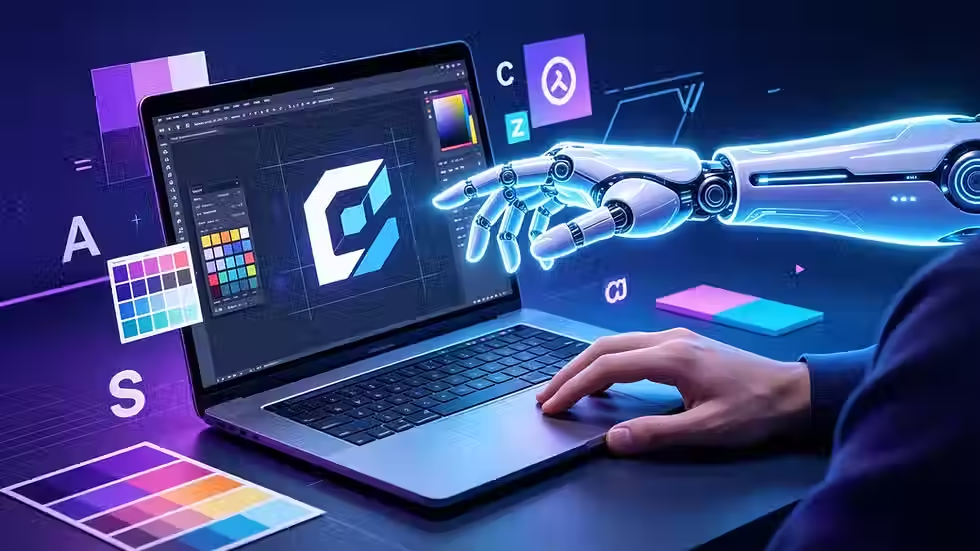
AI marks the next major leap. Modern design tools equipped with machine learning, generative algorithms and neural networks can now interpret instructions, learn from vast libraries of existing work and produce original visual outputs in seconds. This shift moves technology from mere automation to augmentation. Instead of spending hours adjusting curves, aligning elements or experimenting with different colour palettes, designers can delegate these tasks to AI and focus their energy on strategy, storytelling and high-level creative direction.
For example, today’s AI tools can generate multiple layout variations based on a single concept, suggest font combinations that improve readability and brand consistency or even adjust designs to work seamlessly across different formats. These range from billboards and packaging to social media posts and mobile screens. This efficiency alone changes the workflow. Projects that once took days can now be completed in hours, allowing designers to explore more ideas and refine their work more deeply.
Generative AI: A New Era of Creation
The most transformative development in recent years is generative AI, a technology capable of creating entirely new content such as images, patterns, logos, illustrations and even full brand systems based on text prompts, sketches or existing design assets. Unlike traditional software, which follows fixed rules, generative models learn patterns, styles and structures from millions of existing designs, artworks and visual references. This allows them to produce results that are not only technically sound but also diverse and often surprising.
In graphic design, this capability is a major advantage. A designer can describe a concept such as a modern, minimalist logo for a sustainable coffee brand using earth tones and organic shapes. The AI will then generate dozens of distinct options in moments. The designer can then tweak, combine or refine these outputs, using them as a starting point rather than a final product. This speeds up the early brainstorming phase, which is often the most time-consuming part of the process.
In brand design, where consistency and uniqueness are critical, generative AI offers even greater value. It can help build comprehensive visual systems, from logos and typography guidelines to colour palettes, icon sets and marketing visuals. Once a core concept is defined, AI can automatically generate variations suitable for different use cases while maintaining the brand’s visual identity. This is especially useful for businesses operating across multiple channels and markets, ensuring that their look and feel remain coherent everywhere.
Data-Driven Design: Aligning Creativity with Audience Insight
One of the biggest challenges in design has always been uncertainty. Will this visual resonate with the target audience? Will it communicate the right message? Traditionally, designers relied on experience, intuition and limited feedback. AI changes this by bringing data intelligence into the creative process.
Modern AI systems can analyse vast amounts of data including audience demographics, behaviour patterns, market trends, competitor visuals and even emotional responses to identify what works and what does not. They can determine which colours, shapes, typography styles and compositions are most likely to attract attention, build trust and drive engagement. This turns design from a largely subjective process into one that is more informed and strategic.
For brands, this means their visual identity is not only aesthetically pleasing but also aligned with the preferences and expectations of their customers. AI can also run simulations or A/B tests of different design concepts, predicting which one will perform better before it is even launched. This reduces risk and increases the likelihood that the final design will support the brand’s goals, whether that is increasing recognition, boosting sales or building long-term loyalty.
Personalisation and Scalability
In today’s digital world, brands need to communicate across many platforms and to diverse audiences. A one-size-fits-all approach no longer works. Customers expect experiences that feel tailored to them, and this extends to visual communication.
AI enables mass personalisation at scale. It can take a single core brand design and adapt it automatically for different regions, languages, cultures and user segments. For example, a global brand can use AI to adjust colour schemes or imagery to fit local cultural preferences while keeping the logo and core elements consistent. It can also create dynamic content such as personalised product recommendations, email graphics or social media visuals that change in real time based on user data.
This level of scalability was impossible before AI. Without it, maintaining a consistent yet adaptable brand identity across hundreds or thousands of touchpoints would require a large team and significant resources. With AI, even small businesses can achieve the same level of sophistication that was once reserved for large corporations.
Challenges: Originality, Ethics and the Human Role
Despite its benefits, the rise of AI in design also raises important questions and challenges. One of the most debated issues is originality and copyright. Since AI models learn from existing work, there is concern that outputs may inadvertently replicate elements from copyrighted designs or artworks. This raises legal and ethical questions about ownership. Who owns a design created with AI? Is it the tool, the user who provided the prompt or the original creators whose work was used to train the model? As laws and regulations evolve, the industry is working to establish clear guidelines to protect creators and ensure fair use.
Another concern is the risk of homogenisation. If many designers rely on the same datasets and algorithms, there is a possibility that designs will start to look similar, lacking the unique character and distinctiveness that define strong brands. This is where the human designer remains essential. AI provides the building blocks, but it is the human who brings the vision, the understanding of brand values and the ability to create something truly meaningful and memorable.
There is also the fear that AI will replace designers. In reality, the opposite is more likely. As AI handles repetitive and time-consuming tasks, designers are freed to focus on higher-level work. This includes defining strategy, understanding the brand’s story, interpreting audience insights and adding emotional depth and cultural relevance. The role of the designer is shifting from maker to curator, strategist and storyteller. Those who learn to collaborate effectively with AI will find themselves more productive and creative than ever before.
The Future: Collaboration Over Competition
Looking ahead, the relationship between AI and design will continue to evolve, but the core principle will remain collaboration. AI will become more intuitive, capable of understanding not just instructions but also the intent, emotion and context behind a design request. It will help solve complex problems, adapt to new technologies and respond faster to changing market conditions.
At the same time, human creativity will remain irreplaceable. Design is ultimately about communication and connection, about translating ideas, values and emotions into visual form. It requires empathy, cultural awareness and an understanding of human psychology, qualities that AI cannot replicate. The most successful designs of the future will be those that combine the efficiency and intelligence of AI with the insight, intuition and imagination of human designers.
Conclusion
Artificial intelligence is reshaping graphic and brand design in ways that were unimaginable a decade ago. It is changing workflows, expanding creative possibilities, making design more data-driven and allowing brands to scale and personalise their visual identity like never before. While it brings challenges related to originality, ethics and the role of the designer, it also opens doors to new opportunities for innovation and growth.
In this new era, the goal is not to choose between human creativity and AI but to bring them together. By embracing AI as a powerful tool and partner, designers and brands can create work that is not only attractive and consistent but also meaningful, effective and deeply connected to the people they serve. The future of design is not just about what technology can do. It is about what we can achieve when we combine the best of human and machine intelligence.
Summary
For many years, design relied on manual skill and intuition. Today, AI tools such as machine learning algorithms and generative models have changed this landscape completely. They allow designers to produce concepts faster, test ideas against audience data and adapt visual identities across different platforms and markets. However, important questions remain about ownership, uniqueness and the risk of generic outcomes. This article argues that AI will not replace designers but will shift their role towards strategy and storytelling. By working alongside AI, professionals can deliver more consistent, relevant and effective brand experiences.
My name is Gareth Wright, and I am a professional graphic designer with over 20 years of experience in creating visually compelling designs that help businesses stand out. In today's competitive market, effective visual communication is essential. I offer a wide range of graphic design services tailored to meet your specific needs.


Comments